Tinker dex 代码修复解析

Tinker dex 代码修复

Dex 代码的修复方案是 classloader 机制。具体原理是将修复后的 dex 文件插入到 dex 数组的最前面。

加载dex

众所周知,Android 工程的 java 代码会被编译打包放在 dex 文件中。dex 结构图如下:

dex结构图

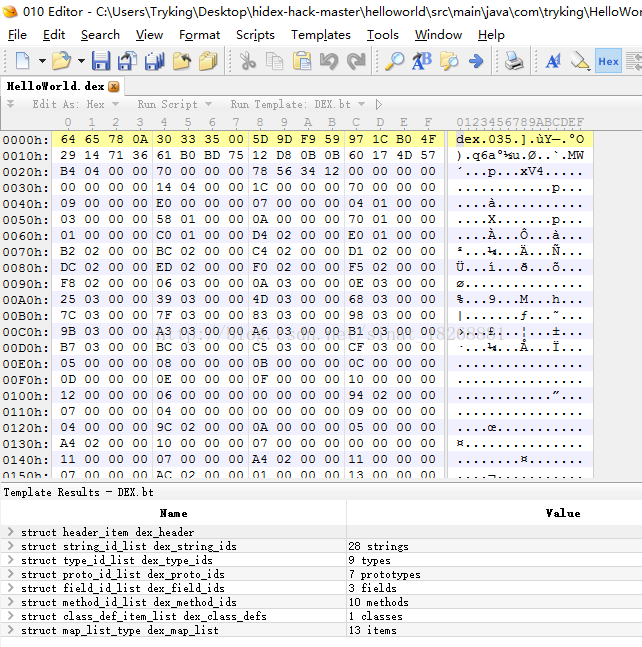
使用 010Editor 程序可以清晰查看 dex 文件:

010查看dex文件

dex 的 diff

dex 文件的差分采用了微信自研的 DexDiff 算法。相比 BsDiff 以文件粒度进行差分,DexDiff 算法深度利用Dex的格式来减少差异的大小,粒度更小。

dex 差分的入口是在 DexPatchGenerator 类。

1
2
3
4
// 构造函数传入了新 dex 文件和老 dex 文件,Dex 的构造函数会将文件解析转换为 Dex 对象
public DexPatchGenerator(File oldDexFile, File newDexFile) throws IOException {
this(new Dex(oldDexFile), new Dex(newDexFile));
}

executeAndSaveTo 用来生成差分包。它对 dex 各区域的数据分别进行差分:

1
2
3
4
5
6
7
8
9
10
11
12
13
14
15
16
17
18
19
20
21
22
23
24
25
26
27
28
29
30
31
32
33
34
35
36
37
38
39
40
41
42
43
44
45
46
47
48
49
50
51
52
53
54
55
56
57
58
59
60
61
62
63
64
65
66
67
68
69
70
71
72
73
74
75
76
77
78
79
80
81
82
83
84
85
86
87
88
89
90
91
92
93
94
95
96
97
98
99
100
101
102
103
104
105
106
public void executeAndSaveTo(OutputStream out) throws IOException {
// Firstly, collect information of items we want to remove additionally
// in new dex and set them to corresponding diff algorithm implementations.
Pattern[] classNamePatterns = new Pattern[this.additionalRemovingClassPatternSet.size()];
int classNamePatternCount = 0;
for (String regExStr : this.additionalRemovingClassPatternSet) {
classNamePatterns[classNamePatternCount++] = Pattern.compile(regExStr);
}
List<Integer> typeIdOfClassDefsToRemove = new ArrayList<>(classNamePatternCount);
List<Integer> offsetOfClassDatasToRemove = new ArrayList<>(classNamePatternCount);
for (ClassDef classDef : this.newDex.classDefs()) {
String typeName = this.newDex.typeNames().get(classDef.typeIndex);
for (Pattern pattern : classNamePatterns) {
if (pattern.matcher(typeName).matches()) {
typeIdOfClassDefsToRemove.add(classDef.typeIndex);
offsetOfClassDatasToRemove.add(classDef.classDataOffset);
break;
}
}
}
((ClassDefSectionDiffAlgorithm) this.classDefSectionDiffAlg)
.setTypeIdOfClassDefsToRemove(typeIdOfClassDefsToRemove);
((ClassDataSectionDiffAlgorithm) this.classDataSectionDiffAlg)
.setOffsetOfClassDatasToRemove(offsetOfClassDatasToRemove);
// Then, run diff algorithms according to sections' dependencies.
// Use size calculated by algorithms above or from dex file definition to
// calculate sections' offset and patched dex size.
// Calculate header and id sections size, so that we can work out
// the base offset of typeLists Section.
int patchedheaderSize = SizeOf.HEADER_ITEM;
int patchedStringIdsSize = newDex.getTableOfContents().stringIds.size * SizeOf.STRING_ID_ITEM;
int patchedTypeIdsSize = newDex.getTableOfContents().typeIds.size * SizeOf.TYPE_ID_ITEM;
// Although simulatePatchOperation can calculate this value, since protoIds section
// depends on typeLists section, we can't run protoIds Section's simulatePatchOperation
// method so far. Instead we calculate protoIds section's size using information in newDex
// directly.
int patchedProtoIdsSize = newDex.getTableOfContents().protoIds.size * SizeOf.PROTO_ID_ITEM;
int patchedFieldIdsSize = newDex.getTableOfContents().fieldIds.size * SizeOf.MEMBER_ID_ITEM;
int patchedMethodIdsSize = newDex.getTableOfContents().methodIds.size * SizeOf.MEMBER_ID_ITEM;
int patchedClassDefsSize = newDex.getTableOfContents().classDefs.size * SizeOf.CLASS_DEF_ITEM;
int patchedIdSectionSize =
patchedStringIdsSize
+ patchedTypeIdsSize
+ patchedProtoIdsSize
+ patchedFieldIdsSize
+ patchedMethodIdsSize
+ patchedClassDefsSize;
this.patchedHeaderOffset = 0;
// The diff works on each sections obey such procedure:
// 1. Execute diff algorithms to calculate indices of items we need to add, del and replace.
// 2. Execute patch algorithm simulation to calculate indices and offsets mappings that is
// necessary to next section's diff works.
// Immediately do the patch simulation so that we can know:
// 1. Indices and offsets mapping between old dex and patched dex.
// 2. Indices and offsets mapping between new dex and patched dex.
// These information will be used to do next diff works.
//对字符串区域的差分
this.patchedStringIdsOffset = patchedHeaderOffset + patchedheaderSize;
if (this.oldDex.getTableOfContents().stringIds.isElementFourByteAligned) {
this.patchedStringIdsOffset
= SizeOf.roundToTimesOfFour(this.patchedStringIdsOffset);
}
this.stringDataSectionDiffAlg.execute();
this.patchedStringDataItemsOffset = patchedheaderSize + patchedIdSectionSize;
if (this.oldDex.getTableOfContents().stringDatas.isElementFourByteAligned) {
this.patchedStringDataItemsOffset
= SizeOf.roundToTimesOfFour(this.patchedStringDataItemsOffset);
}
this.stringDataSectionDiffAlg.simulatePatchOperation(this.patchedStringDataItemsOffset);
......
this.classDefSectionDiffAlg.execute();
this.patchedClassDefsOffset = this.patchedMethodIdsOffset + patchedMethodIdsSize;
if (this.oldDex.getTableOfContents().classDefs.isElementFourByteAligned) {
this.patchedClassDefsOffset = SizeOf.roundToTimesOfFour(this.patchedClassDefsOffset);
}
// Calculate any values we still know nothing about them.
this.patchedMapListOffset
= this.patchedEncodedArrayItemsOffset
+ this.encodedArraySectionDiffAlg.getPatchedSectionSize();
if (this.oldDex.getTableOfContents().mapList.isElementFourByteAligned) {
this.patchedMapListOffset = SizeOf.roundToTimesOfFour(this.patchedMapListOffset);
}
int patchedMapListSize = newDex.getTableOfContents().mapList.byteCount;
this.patchedDexSize
= this.patchedMapListOffset
+ patchedMapListSize;
// Finally, write results to patch file.
writeResultToStream(out);
}

差分工作是在 DexSectionDiffAlgorithm.java 中完成的,DexSectionDiffAlgorithm 是个抽象类,它的 execute 方法描述了差分的大致骨架,具体的实现是在各个子类完成的。骨架代码如下:

1
2
3
4
5
6
7
8
9
10
11
12
13
14
15
16
17
18
19
20
21
22
23
24
25
26
27
28
29
30
31
32
33
34
35
36
37
38
39
40
41
42
43
44
45
46
47
48
49
50
51
52
53
54
55
56
57
58
59
60
61
62
63
64
65
66
67
68
69
70
71
72
73
74
75
76
77
78
79
80
81
82
83
84
85
86
87
88
89
90
91
92
93
94
95
96
97
98
99
100
101
102
103
104
105
106
107
108
109
110
111
112
113
114
115
116
117
118
119
120
public void execute() {
this.patchOperationList.clear();
//收集新老 dex 里的数据项、进行排序操作
this.adjustedOldIndexedItemsWithOrigOrder = collectSectionItems(this.oldDex, true);
this.oldItemCount = this.adjustedOldIndexedItemsWithOrigOrder.length;
AbstractMap.SimpleEntry<Integer, T>[] adjustedOldIndexedItems = new AbstractMap.SimpleEntry[this.oldItemCount];
System.arraycopy(this.adjustedOldIndexedItemsWithOrigOrder, 0, adjustedOldIndexedItems, 0, this.oldItemCount);
Arrays.sort(adjustedOldIndexedItems, this.comparatorForItemDiff);
AbstractMap.SimpleEntry<Integer, T>[] adjustedNewIndexedItems = collectSectionItems(this.newDex, false);
this.newItemCount = adjustedNewIndexedItems.length;
Arrays.sort(adjustedNewIndexedItems, this.comparatorForItemDiff);
//使用两个指针遍历新老元素,将新增元素、删除的元素保存到 patchOperationList
int oldCursor = 0;
int newCursor = 0;
while (oldCursor < this.oldItemCount || newCursor < this.newItemCount) {
if (oldCursor >= this.oldItemCount) {
// rest item are all newItem.
while (newCursor < this.newItemCount) {
AbstractMap.SimpleEntry<Integer, T> newIndexedItem = adjustedNewIndexedItems[newCursor++];
this.patchOperationList.add(new PatchOperation<>(PatchOperation.OP_ADD, newIndexedItem.getKey(), newIndexedItem.getValue()));
}
} elseu a
if (newCursor >= newItemCount) {
// rest item are all oldItem.
while (oldCursor < oldItemCount) {
AbstractMap.SimpleEntry<Integer, T> oldIndexedItem = adjustedOldIndexedItems[oldCursor++];
int deletedIndex = oldIndexedItem.getKey();
int deletedOffset = getItemOffsetOrIndex(deletedIndex, oldIndexedItem.getValue());
this.patchOperationList.add(new PatchOperation<T>(PatchOperation.OP_DEL, deletedIndex));
markDeletedIndexOrOffset(this.oldToPatchedIndexMap, deletedIndex, deletedOffset);
}
} else {
AbstractMap.SimpleEntry<Integer, T> oldIndexedItem = adjustedOldIndexedItems[oldCursor];
AbstractMap.SimpleEntry<Integer, T> newIndexedItem = adjustedNewIndexedItems[newCursor];
int cmpRes = oldIndexedItem.getValue().compareTo(newIndexedItem.getValue());
if (cmpRes < 0) {
int deletedIndex = oldIndexedItem.getKey();
int deletedOffset = getItemOffsetOrIndex(deletedIndex, oldIndexedItem.getValue());
this.patchOperationList.add(new PatchOperation<T>(PatchOperation.OP_DEL, deletedIndex));
markDeletedIndexOrOffset(this.oldToPatchedIndexMap, deletedIndex, deletedOffset);
++oldCursor;
} else
if (cmpRes > 0) {
this.patchOperationList.add(new PatchOperation<>(PatchOperation.OP_ADD, newIndexedItem.getKey(), newIndexedItem.getValue()));
++newCursor;
} else {
int oldIndex = oldIndexedItem.getKey();
int newIndex = newIndexedItem.getKey();
int oldOffset = getItemOffsetOrIndex(oldIndexedItem.getKey(), oldIndexedItem.getValue());
int newOffset = getItemOffsetOrIndex(newIndexedItem.getKey(), newIndexedItem.getValue());
if (oldIndex != newIndex) {
this.oldIndexToNewIndexMap.put(oldIndex, newIndex);
}
if (oldOffset != newOffset) {
this.oldOffsetToNewOffsetMap.put(oldOffset, newOffset);
}
++oldCursor;
++newCursor;
}
}
}
// So far all diff works are done. Then we perform some optimize works.
// detail: {OP_DEL idx} followed by {OP_ADD the_same_idx newItem}
// will be replaced by {OP_REPLACE idx newItem}
Collections.sort(this.patchOperationList, comparatorForPatchOperationOpt);
//针对 index 相同的 OP_DEL 和 OP_ADD 操作,将其转换为 OP_REPLACE
Iterator<PatchOperation<T>> patchOperationIt = this.patchOperationList.iterator();
PatchOperation<T> prevPatchOperation = null;
while (patchOperationIt.hasNext()) {
PatchOperation<T> patchOperation = patchOperationIt.next();
if (prevPatchOperation != null
&& prevPatchOperation.op == PatchOperation.OP_DEL
&& patchOperation.op == PatchOperation.OP_ADD
) {
if (prevPatchOperation.index == patchOperation.index) {
prevPatchOperation.op = PatchOperation.OP_REPLACE;
prevPatchOperation.newItem = patchOperation.newItem;
patchOperationIt.remove();
prevPatchOperation = null;
} else {
prevPatchOperation = patchOperation;
}
} else {
prevPatchOperation = patchOperation;
}
}
// Finally we record some information for the final calculations.
//把增加元素、删除元素、修改元素的操作分别存放到三个集合中
patchOperationIt = this.patchOperationList.iterator();
while (patchOperationIt.hasNext()) {
PatchOperation<T> patchOperation = patchOperationIt.next();
switch (patchOperation.op) {
case PatchOperation.OP_DEL: {
indexToDelOperationMap.put(patchOperation.index, patchOperation);
break;
}
case PatchOperation.OP_ADD: {
indexToAddOperationMap.put(patchOperation.index, patchOperation);
break;
}
case PatchOperation.OP_REPLACE: {
indexToReplaceOperationMap.put(patchOperation.index, patchOperation);
break;
}
default: {
break;
}
}
}
}

最后调用 DexPatchGenerator.java 的 writePatchOperations 方法将 patch 信息写入差分包文件中:

1
2
3
4
5
6
7
8
9
10
11
12
13
14
15
16
17
18
19
20
21
22
23
24
25
26
27
28
29
30
31
32
33
34
35
36
37
38
39
40
41
42
43
44
45
46
47
48
49
50
51
52
53
54
55
56
57
58
59
60
61
private <T extends Comparable<T>> void writePatchOperations(
DexDataBuffer buffer, List<PatchOperation<T>> patchOperationList
) {
List<Integer> delOpIndexList = new ArrayList<>(patchOperationList.size());
List<Integer> addOpIndexList = new ArrayList<>(patchOperationList.size());
List<Integer> replaceOpIndexList = new ArrayList<>(patchOperationList.size());
List<T> newItemList = new ArrayList<>(patchOperationList.size());
for (PatchOperation<T> patchOperation : patchOperationList) {
switch (patchOperation.op) {
case PatchOperation.OP_DEL: {
delOpIndexList.add(patchOperation.index);
break;
}
case PatchOperation.OP_ADD: {
addOpIndexList.add(patchOperation.index);
newItemList.add(patchOperation.newItem);
break;
}
case PatchOperation.OP_REPLACE: {
replaceOpIndexList.add(patchOperation.index);
newItemList.add(patchOperation.newItem);
break;
}
default:
break;
}
}
buffer.writeUleb128(delOpIndexList.size());
int lastIndex = 0;
for (Integer index : delOpIndexList) {
buffer.writeSleb128(index - lastIndex);
lastIndex = index;
}
buffer.writeUleb128(addOpIndexList.size());
lastIndex = 0;
for (Integer index : addOpIndexList) {
buffer.writeSleb128(index - lastIndex);
lastIndex = index;
}
buffer.writeUleb128(replaceOpIndexList.size());
lastIndex = 0;
for (Integer index : replaceOpIndexList) {
buffer.writeSleb128(index - lastIndex);
lastIndex = index;
}
for (T newItem : newItemList) {
if (newItem instanceof StringData) {
buffer.writeStringData((StringData) newItem);
} else
if (newItem instanceof Integer) {
// TypeId item.
buffer.writeInt((Integer) newItem);
}
......
}
}

以字符串的 diff 过程为例, 假设老 dex 文件中字符串序列为 “c”、”a”、”d”、”e” ,新dex 文件中字符串序列为 “c”、”b”、”e”、”f”

先收集字符串序列,老字符串序列为 {0,”c”},{1,”a”},{2,”d”},{3,”e”},新字符串序列为 {0,”c”},{1,”b”},{2,”e”},{3,”f”}

排序后的序列分别为 {1,”a”},{0,”c”},{2,”d”},{3,”e”} 和 {1,”b”},{0,”c”},{2,”e”},{3,”f”}

使用指针 oldCursor、newCursor 遍历后得到的操作序列为 {OP_DEL,1}、{OP_ADD,1,”b”}、{OP_DEL,2}、{OP_ADD,3,”f”}

对操作序列进行排序和合并后得到序列: {OP_REPLACE,1,”b”}、{OP_DEL,2}、{OP_ADD,3,”f”}

将信息写入 patch 包对 StringData 区域中:

各个区域的差分信息都写入 patch 包后,生成的 patch 包格式如下:
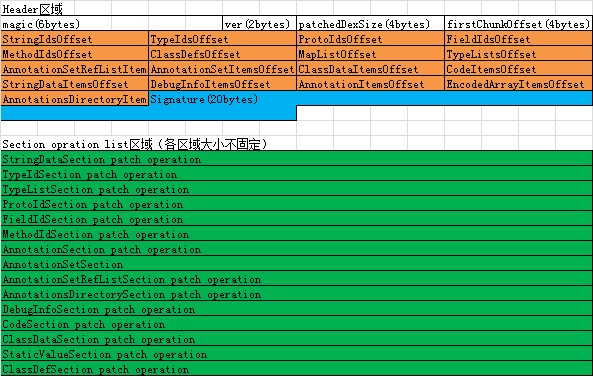
微信自定义patch包格式

参考链接:

Android 热修复 Tinker 源码分析之DexDiff / DexPatch

tinker-dex-dump

Dalvik Executable format

一篇文章带你搞懂DEX文件的结构

安卓App热补丁动态修复技术介绍